
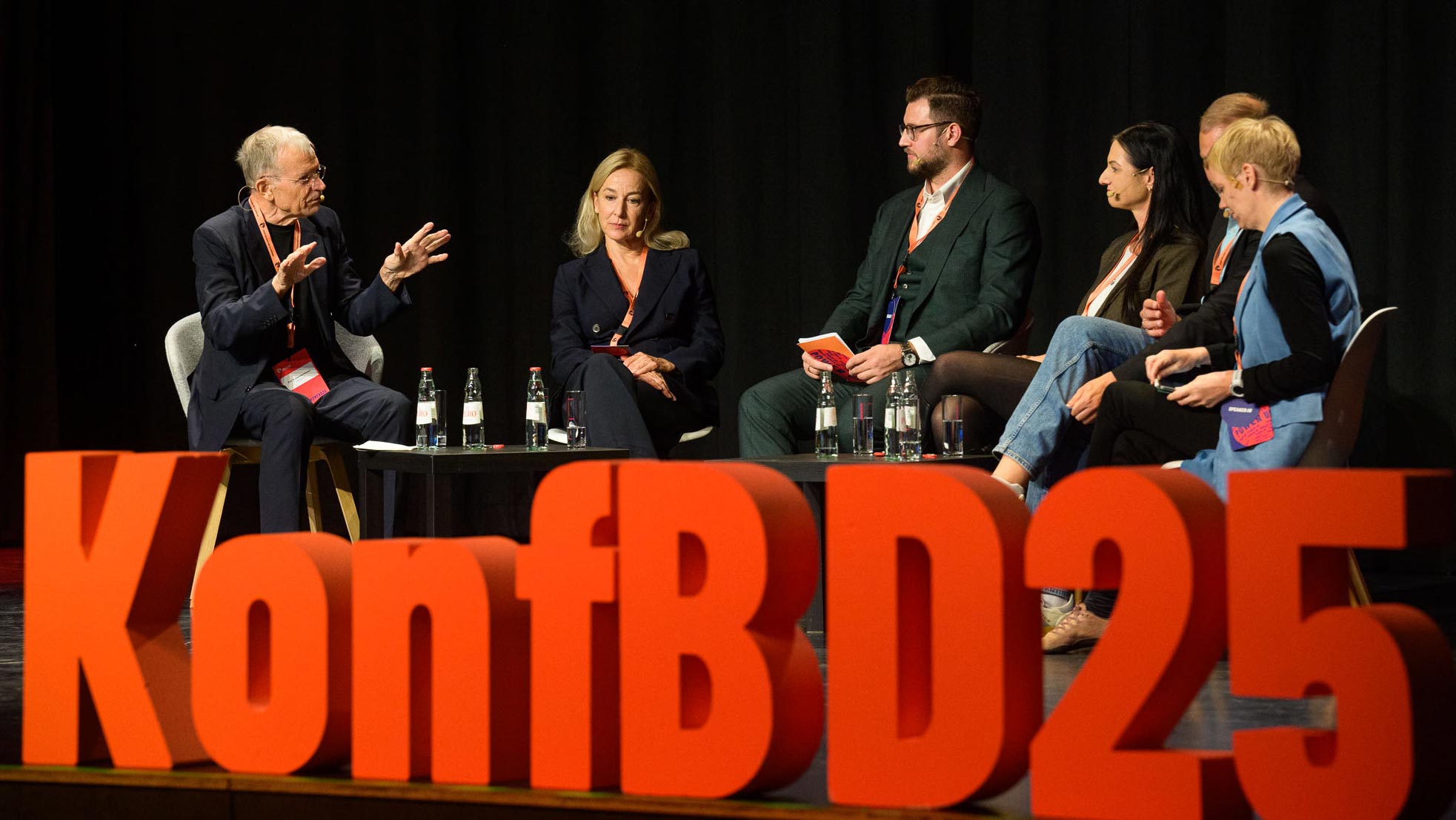
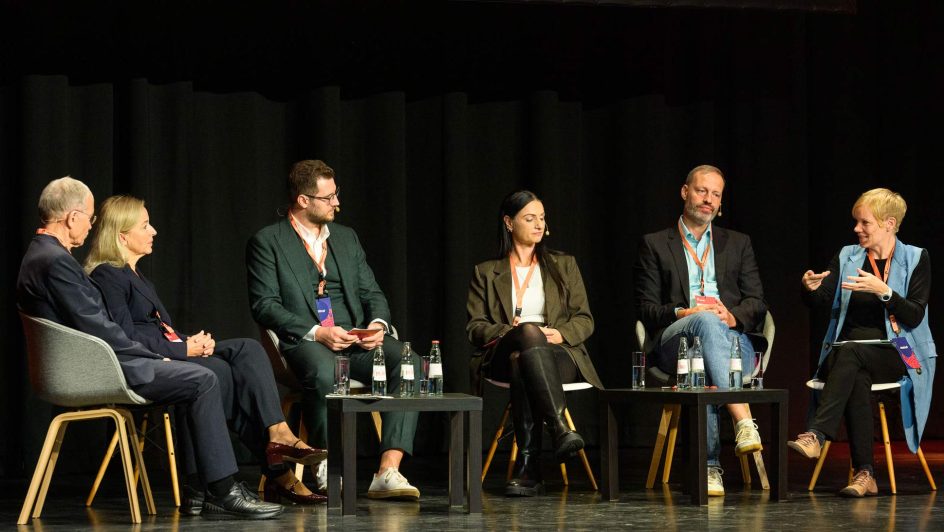






Prof. Dr. Klaus Hurrelmann, Prof. Dr. Uta Hauck-Thum, Fabian Franz (moderator), Kristin van der Meer, Micha Pallesche, and Prof. Dr. Felicitas Macgilchrist in conversation at KonfBD2.
© Forum Bildung Digitalisierung; Photographer: Phil Dera
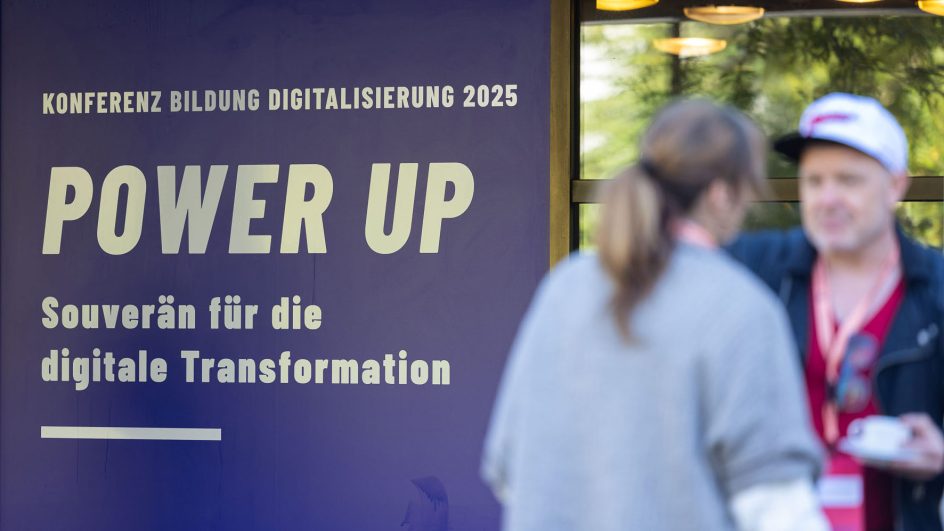
On September 24-25, 2025, the Education Digitalization Conference #KonfBD2025 brought together over 1,000 representatives from education, research, politics, and civil society at the Urania Berlin. Under the motto “POWER UP – Sovereignty in the Digital Transformation,” the conference focused on sustainable and equitable education in Germany.
The conference speakers highlighted that there is no lack of knowledge – but rather a lack of speed in implementation. Federal Education Minister Karin Prien spoke openly about Germany’s “difficulties with implementation,” and education researcher John Hattie summed it up: “Speed it up!” – an appeal that became the conference’s catchphrase.
From democratic education to disinformation and artificial intelligence (AI) – the conference made it clear that digital sovereignty is the basis for educational equity and democratic competence. Bans alone slow things down; instead, we need the courage to experiment and political support for teachers. Foundations play a crucial role here because they provide independent impetus, test new approaches, and connect actors from different fields.
“We are concerned with digitality, we see it as a central driver of social change that is completely redefining education, participation, and sustainability,” emphasizes Dr. Nina Smidt from Siemens Stiftung. “Digitality is more than just equipment. It shapes a networked, fluid, and algorithmic reality that opens up new perspectives on learning.”
In the panel discussion “Beyond the instrumental: Education under the conditions of digitality – from attitude to skills acquisition for future generations“, with Klaus Hurrelmann, Felicitas Macgilchrist, Kristin van der Meer, Uta Hauck-Thum, and Micha Pallesche, Siemens Stiftung discussed key questions about education under the conditions of digitality. The core messages:
Digitality is more than technology – it is about cultural practices, values, and participation. Education must focus on this dimension.
Schools should not only teach, but also be active places for engaging with digitality.
Innovative approaches and best practices must be made visible, shared, and flexibly adapted to different contexts.
Transformation can only succeed through the interaction of politics, research, practice, and civil society – no single actor can accomplish the task alone.
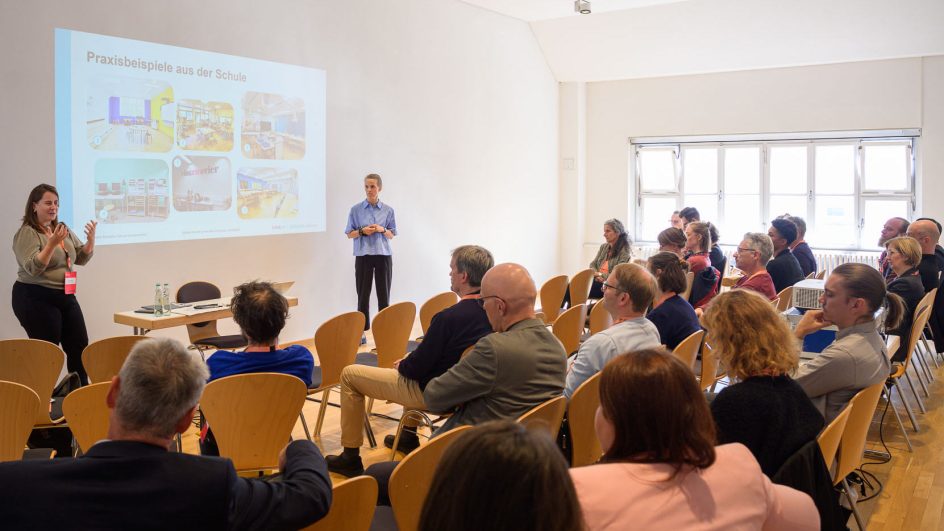
With Franziska von Einem and Sabrina Konzok, Siemens Stiftung presented: How maker education opens up learning spaces for creativity and innovation. One example is the STEAM Hub in Siemensstadt Square, an extracurricular learning center for practical, digital work and ideas for the future.
The #KonfBD2025 conference showed that digital transformation in education can only succeed if we see it as a shared task—across schools, research, politics, civil society, and foundations. As a non-profit foundation and founding member of the Forum Bildung Digitalisierung, our task is to provide independent impetus, highlight innovative approaches, and effectively connect stakeholders. Now it is time to take the spirit from Berlin and continue working to strengthen digital sovereignty and creative power in all learning environments – so that education becomes equitable and sustainable in the digital age.


Our newsletter keeps you informed about our work in the action areas of Essential Services, Digitality, and Climate.
Every two to three months, you’ll receive updates on important topics, projects, calls for proposals, training opportunities, and events.
Our newsletter keeps you informed about our work in the areas of primary care, digitalization, and climate.
Every two to three months, you’ll receive updates on important topics, projects, calls for proposals, training opportunities, and events.