

StaRK
Strengthening self-regulation skills in early childhood education
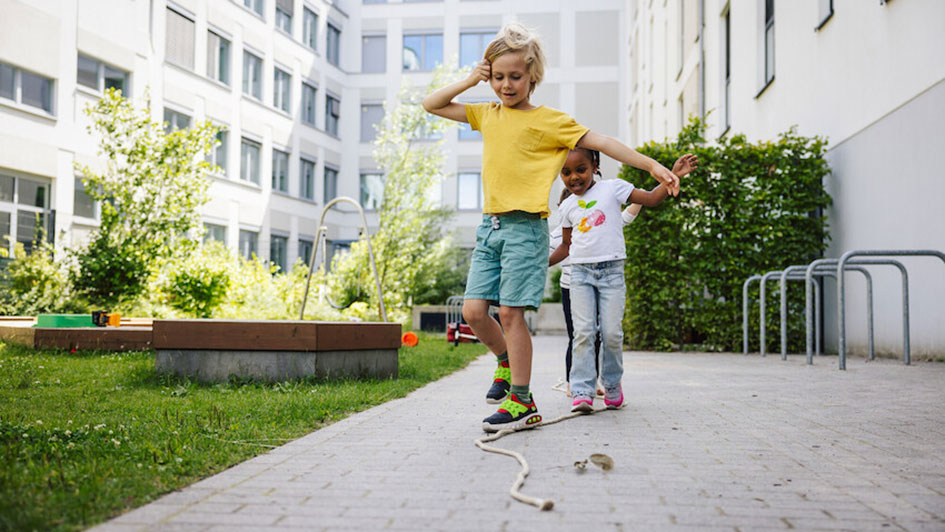
How do children learn to deal with emotions, challenges, and new situations? This is exactly where the StaRK project comes in (SRK stands for “self-regulation competence”), which was launched by the Kinder forschen Foundation in collaboration with Charité – Universitätsmedizin Berlin. The program is funded by hkk Health Insurance, the RWE Foundation, and the Siemens Stiftung. The goal is to strengthen the self-regulation skills of children aged three to six and thereby lay important foundations for resilience, health, and educational success at an early stage.
Why self-regulation matters
Self-regulation skills help children to:
- consciously manage emotions and behavior,
- cope with challenges and stress,
- learn with focus and concentration, and
- build positive social relationships.
Studies show that well-developed self-regulation skills can have long-term positive effects on health, well-being, and social participation. Supporting these skills is especially important for children growing up in socially disadvantaged environments (see, for example, the Dunedin Study).
Developing new approaches together
Based on the proven Australian program PRSIST (Preschool Situational Self-Regulation Toolkit), new professional development programs and materials for early childhood education are being developed. The content is being tested through a co-creative process with early childhood educators.
These workshops will take place at the Siemens Stiftung’s MINT Hub in Berlin-Spandau. With its diverse social realities, the region provides an important testing ground for developing effective and needs-based approaches.
The goal of the project is to provide practical training not only to children but also to early childhood educators and preschool directors, and to make information and materials available. See the current professional development offerings below.
The project builds on the call by the German National Academy of Sciences Leopoldina to more firmly anchor self-regulation skills as a guiding principle in the German education system.
Current Continuing Education Opportunities
90-minute webinar (German language)
During the 90-minute webinar, participants will learn what self-regulation entails and, using the example of discovery-based learning and inquiry-based learning, how to foster self-regulation in everyday life. For example, children can practice impulse control by first formulating hypotheses, planning their approach, and waiting their turn.
Working memory is also exercised during collaborative inquiry, such as when children recall their most important findings. At the same time, the webinar addresses situations where preschool teachers’ self-regulation skills are needed—such as when they must tolerate a child’s frustration if the outcome of a research project differs from what was hoped for.
The webinar will be offered twice in the fall of 2026 (German language)
- Monday, September 28, 2026, 4:00–5:30 p.m.
- Thursday, November 19, 2026, 4:30–6:00 p.m.
The first dates for 2027 have already been set. All dates and registration are handled through Campus, the digital learning platform of the Stiftung Kinder forschen.
Online Course Covers the Basics (German language)
In addition to the webinar, there is an online self-study course. It is available on the Stiftung Kinder forschen campus page and addresses fundamental questions about self-regulation: What is self-regulation? Why is it important, and how do children develop self-regulation skills? How can educators create a supportive learning environment, and what role does play have in all of this?
The online course, titled “The Tower Falls Over—Now What? Promoting Self-Regulation,” will also be available free of charge starting in early September 2026.


