When knowledge travels, impact grows
How collaboration is advancing STEM+ education across Latin America
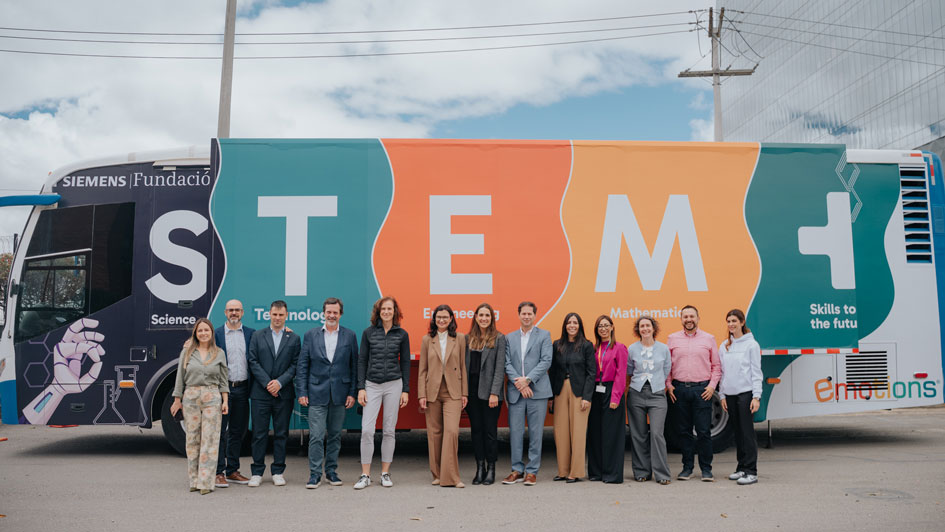
Team Siemens, Siemens Stiftung, Fundación Siemens Colombia at a STEM+ project in Colombia
© Fundación Siemens Colombia
The challenges societies face today are increasingly interconnected, from
unequal access to education and basic services to climate change and the rapid pace of technological transformation. Addressing them requires more than individual initiatives. It takes long-term commitment, local knowledge, different areas of expertise, and, above all, collaboration.
A shared ambition lies at the heart of the Global Alliance of Siemens
Foundations: to advance inclusive and sustainable development, with education
and social innovation as key drivers of lasting change. The Alliance brings
together independent, locally rooted foundations in Argentina, Brazil, Colombia,
Denmark, France and the United States, alongside the international Siemens
Stiftung, headquartered in Germany. Working globally with an extensive partner
network across Latin America, North America, Africa, Asia and Europe, Siemens
Stiftung connects the local foundations’ deep knowledge of their communities
with its global perspective and vision for inclusive and sustainable development.
The strength of such a network lies not only in what each foundation can
achieve locally, but in what becomes possible when knowledge, experience, and
ideas are shared across borders. Approaches can be adapted to new contexts,
partners can learn from one another, and local initiatives can become part of
broader solutions. In this sense, the network also brings the idea of ONE to social engagement:
different organizations contributing their individual strengths while working
toward common goals by sharing their knowledge, tools and learning materials.
Latin America offers a strong example of what this can look like in practice.
Skills for a changing world
At the heart of this collaboration is STEM+ education. It combines science,
technology, engineering, and mathematics with perspectives from other
disciplines and real-world contexts, helping young people develop the
competencies they need in a rapidly changing technological and environmental
context.
But improving access to education is only part of the ambition. The network also
creates connections between institutions and educators, enabling knowledge
and successful approaches to travel beyond individual classrooms, organizations,
or countries.
This was also a focus during a recent visit to Chile and Colombia by Judith Wiese,
Chief People and Sustainability Officer and member of the Managing Board of
Siemens AG, and Dr. Nina Smidt, CEO of Siemens Stiftung. Together, they met
with representatives from universities, schools, civil society organizations, and
the private sector to explore how stronger regional cooperation can connect
institutions, foster knowledge exchange, and further advance equitable access to
quality education.
Connecting a region through education
Across Latin America, collaboration around STEM+ education has developed into
an extensive regional ecosystem. For more than a decade, the international Siemens Stiftung has managed the Red STEM Latinoamérica network, which today connects more than 200 partner institutions in 14 countries, 58 STEM+ Territories in eight countries, seven regional STEM+ Working Tables, and more than 2,500 educators.
Among the partners are the regional Siemens foundations in Argentina, Brazil,
and Colombia. Together with teachers, universities, education experts,
policymakers, civil society organizations, and the private sector, they contribute
local experience and expertise while benefiting from knowledge created
elsewhere in the network.
Educational challenges often cross borders, but solutions must respond to local
realities. Through Red STEM Latinoamérica, Siemens Stiftung connects people,
knowledge, and resources to develop educational approaches that can be
adapted and shared across communities. This advances a learning ecosystem to
expand access to quality education in the region.
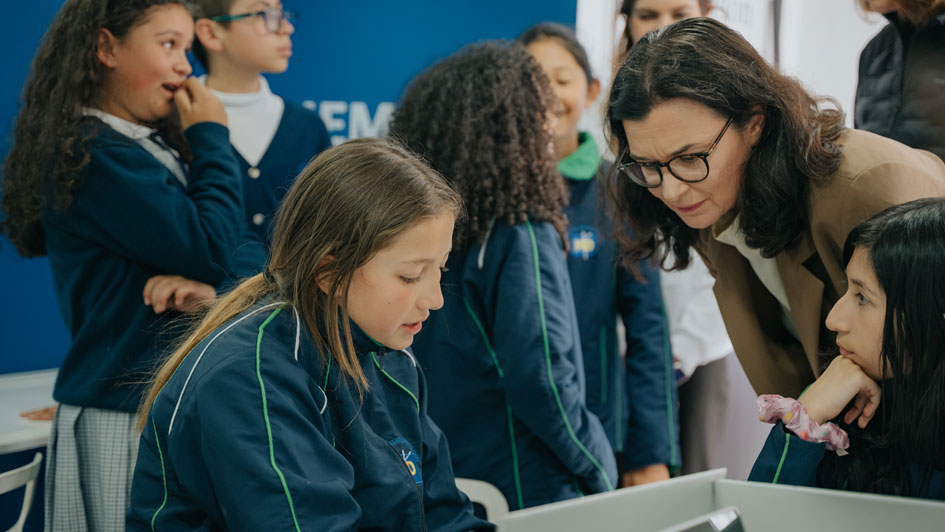
20 years of creating opportunities together
The visit of Judith Wiese and Nina Smidt also marked an important milestone:
the 20th anniversary of Fundación Siemens Colombia. For two decades, the foundation has built partnerships across sectors to advance
sustainable development through science, technology, innovation, and
collaborative action. Its work has helped expand access to STEM+ education,
healthcare, humanitarian assistance, and essential services, including safe water,
across different regions of Colombia.
The anniversary therefore represents more than 20 years of individual projects. It
highlights the value of sustained partnerships and the role local organizations
can play in connecting the needs of communities with knowledge, resources,
and expertise.
The occasion offered an opportunity both to look back and to look ahead: at how
partnerships built over time can continue to open opportunities for people and
communities as their needs evolve.
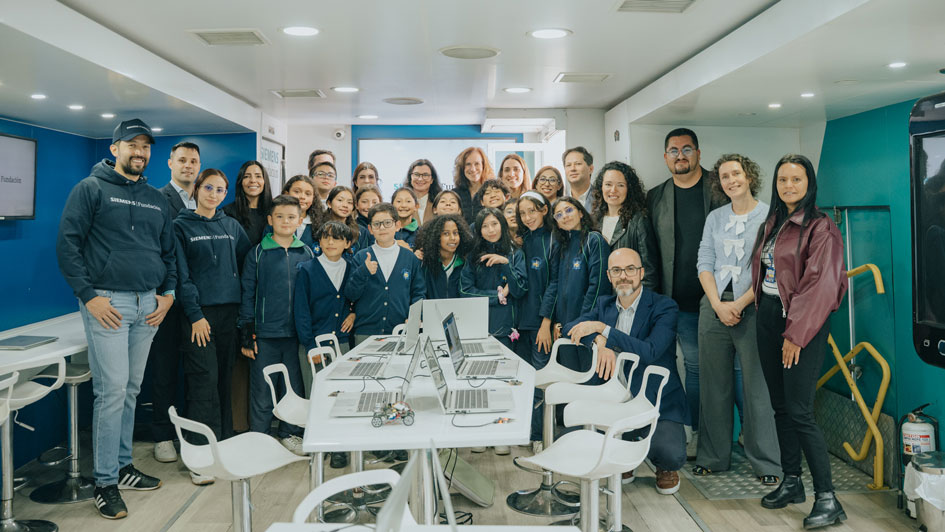
Stronger when knowledge is shared
The example of Latin America shows why networks matter in social engagement.
Local foundations and partners have the proximity and experience to understand
the challenges communities face. A broader network makes it possible to
connect this local expertise, learn across countries and organizations, and build
on approaches that have already shown potential elsewhere. That is where collaboration can multiply impact: not by making every initiative
the same, but by making knowledge accessible to others.
And it is what turns a network of individual organizations into something more:
a community that learns from one another, connects local action with global
expertise, and creates opportunities that can extend far beyond a single project
or partnership.
This article was published in Siemens World by Anne Kinalzyk