


Medellín’s resurrection through education
“Until the lions have their own historians, the history of the hunt will always glorify the hunter”, the words of Nigerian author Chinua Achebe play in my mind on a loop, as I marvel at Medellín, Colombia’s second–largest city. As an avid consumer of English mainstream media for decades, it’s easy to fall prey to narratives that “other” non-dominant cultures. Recent series on popular streaming platforms do Medellín a profound disservice by portraying it through a monolithic lens, stripping the city and its people of agency and self-representation. As Edward Said argued in his landmark book “Orientalism”, cultural representation is deeply intertwined with geopolitical power.
This travelogue is written by Jagori Dhar from Siemens Stiftung
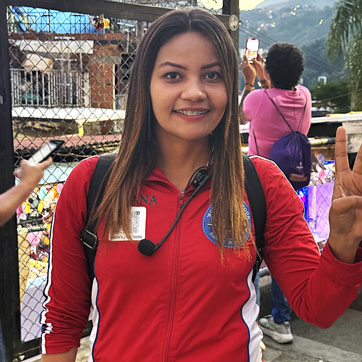
Tour guide, Julia Carson, takes a group of visitors for a tour of Comuna 13 in Medellín city, leading the way through the meandering streets. Joining the group, I quickly realized she was doing far more than pointing out artistic graffiti and exclusive local merchandise; she opened one of the darkest chapters of the city’s history. A survivor, the 29-year-old still waits to receive the remains of her grandfather, who went missing over two decades ago.
She became a community guide two years ago, narrating Comuna 13’s transformation journey both as a responsibility and redemption. Once one of Medellín’s most notorious neighbourhoods, it was left with deep physical and psychological scars. Today, the youth have reclaimed their streets through vibrant grassroots artistic movements and entrepreneurship. “People say change comes from governments, but for us, real change came from people. Culture replaced violence: Today, hip-hop, street art, and education have become powerful tools for reassertion, Julia reflects. Her generation is rewriting the story that is now told by the people who lived it.
We soaked in the sights and sounds of the dynamic district, ending the tour beneath a towering phoenix artwork, standing tall as a powerful metaphor for Medellín’s remarkable transformation. Rising from the ashes, the city has reinvented itself through education, innovation, and community action. This journey gained international recognition in 2019 when Medellín received the UNESCO Learning City Award, honoring its outstanding commitment to inclusive education and lifelong learning as drivers of social transformation. Accepting the award, then Mayor Federico Gutiérrez captured the city’s vision: “Only with education do we close the social gaps and overcome the vicious circle of violence and poverty.”
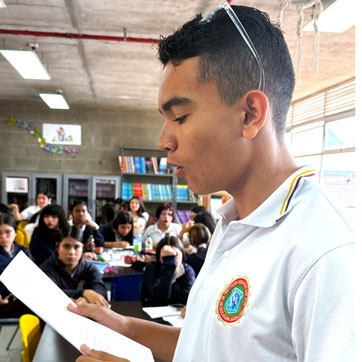
I had the opportunity to experience this at the Colegio San José de Itaguí. 14-year-old Manuel Quintero stands before his classmates, reading a letter he has written to one of the young protagonists of “La Cuadra” (The Street) by Colombian author Gilmer Mesa. The semi-autobiographical novel is a powerful portrayal of life in Medellín’s working-class neighborhoods during the violent decades of the 80s and 90s. Widely acclaimed for its authenticity, the book tells the story of the conflict through the intimate and lived experiences of the families who endured it, deliberately avoiding the portrayal of stereotypical tropes in popular television dramas.
For Manuel, the story is more than a reflection on the past. It speaks of the realities his generation still faces today. “Many young people in our neighborhoods are not being heard, and they continue to be pushed towards a world of crime,” he says. “We need to remind ourselves how important youth development is. It is closely linked to a country’s development and to building a more stable society. I want to inspire my classmates who may be living under similar circumstances to those described in the book.”
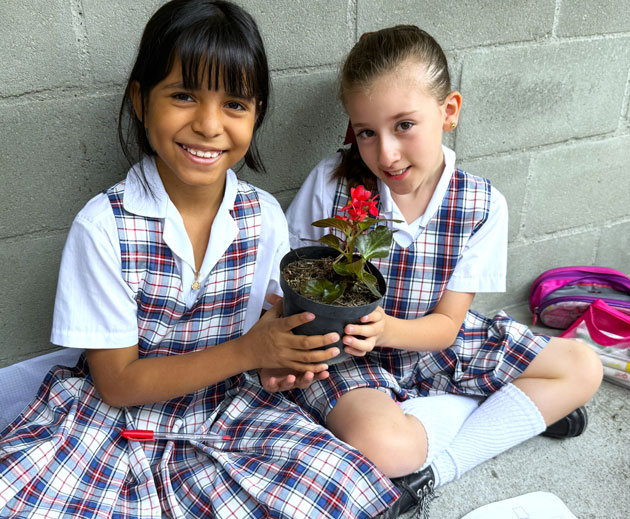
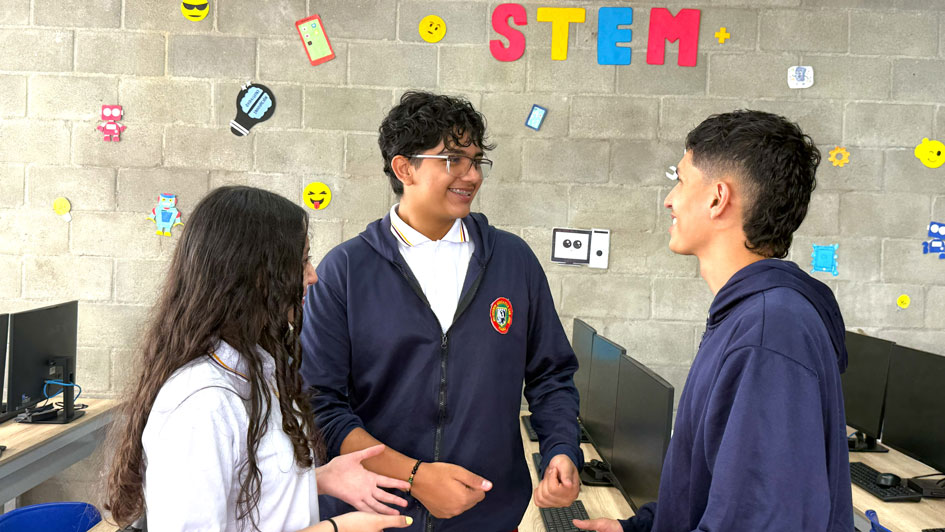
Another group of girls performs a powerful sequence decipting sexual aussault to underscore the importance of women’s empowerment, bodily autonomy, and dignity. These are not extracurricular activities; rather, they are woven into every aspect of learning. Reflecting the schools commitment to STEMplus: The interdisciplinary educational approach integrates Science, Technology, Engineering, and Mathematics, with 21st century competencies, providing young people with agency and confidence. For a company seeking to move ahead, this holistic approach allows them to turn the page on the past and write a new chapter. Students become catalysts for shaping the future.
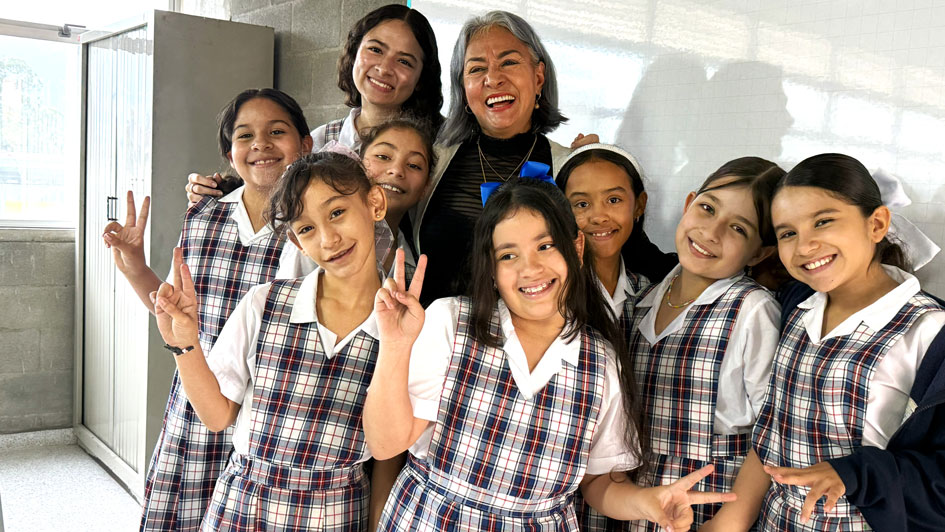
Principal of Colegio San José de Itaguí, Maria Eugenia Mira explains:
“Siemens Stiftung has been a mentor for us, broadening our pedagogical approach to the STEMplus. It is much more than an acronym of Science, Technology, Engineering, and Mathematics; it is our philosophy, a way of being, of acting, and of learning together. I love that it’s visible, it’s felt, it’s lived. It’s not only reflected in our classroom practices from kindergarten through eleventh grade, but also in our bilingual and entrepreneurship programs. A whole culture is emerging: A dynamic, forward-thinking community dedicated to service, well-being, peace, harmony, and coexistence.”
The interdisciplinary STEMplus approach encourages students to experiment, explore, and critically evaluate things within their contexts. Rather than remaining passive observers they become active learners equipped with skills to develop solutions to tackle challenges around them. Today six schools around the Itagüí district and many more in the Medellin metropolitan are area embracing this approach.
“We certainly want the next generation to become good mathematicians or engineers, but our greatest aspiration is that they are also good citizens. It’s promising to see schools strike a balance between developing strong technological competencies along with nurturing students’ social and emotional growth to become engaged and responsible citizens,” says Pollyanna Zapata from the Education Authority in Itagüí.
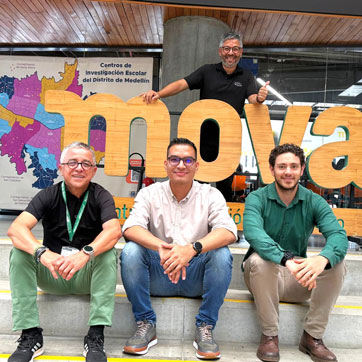
Medellín’s transformation has been driven not only by investing in students but also by empowering teachers as changemakers. At the heart of this effort is Mova, the Teacher Innovation Center, where educators critically reflect on classroom challenges, conduct research, and redesign their schools’ educational projects to respond better to the needs of their communities. At its STEM space, teachers, school administrators, and researchers co-create new approaches to learning. Guided by the city’s public education agenda, it promotes creativity, interdisciplinary collaboration, and continuous professional learning. By positioning teachers as architects of educational change, Mova has become a cornerstone of Medellín’s internationally recognized learning ecosystem and its vision of education as a driver of social transformation.
Combining forces with institutions such as the University of Antioquia connects the University’s academic resources with Mova’s pedagogical space to co-create educational programs and community initiatives. Along with Colegio San José de Itaguí, both institutions are part of the STEM Territories initiative of Red STEM Latinoamérica, joining a regional network of 55 territories in 8 Latin American countries.
Cutting across sectors and countries, these collective impact partnerships collaborate to develop locally driven solutions to societal, environmental, and technological challenges. From July 21-23, the network members convene in Lima, Peru, for the V Encuentro under the theme “Collaborating to Transform: Sustainable Communities and Territories,” reinforcing the shared vision of education as a catalyst for sustainable development.
The scale of this commitment is reflected across Medellín’s education ecosystem, serving nearly 300,000 students in public schools and boasting a higher education enrollment coverage rate of 66.2%, positioning the city as a district for innovation and technology, with strong STEMplus focus.
“My generation was often called the generation with no future,” says Jorge Iván Ríos, Deputy Secretary for the Provision of Educational Services at the Medellín Department of Education. “I lost many friends during the dark decades, but education gave me a different path. Today, my mission is to create opportunities for teachers and students to improve not only their own lives, but also those of their families and communities. Collectively, we have found strength in education to redefine our future with resilience, dignity, and hope.”


Our newsletter keeps you informed about our work in the action areas of Essential Services, Digitality, and Climate.
Every two to three months, you’ll receive updates on important topics, projects, calls for proposals, training opportunities, and events.
Our newsletter keeps you informed about our work in the areas of primary care, digitalization, and climate.
Every two to three months, you’ll receive updates on important topics, projects, calls for proposals, training opportunities, and events.